The Surprising Truth About What Makes Budget EDC Gadgets Truly Durable
Affordable everyday carry gear can look tough without being built to last, and an inexpensive tool can sometimes outlive a more impressive-looking alternative. The difference comes down to more than metal thickness, rugged styling, or a claim of heavy-duty construction. Understanding budget EDC durability factors means looking at material properties, joint design, manufacturing consistency, environmental exposure, and the way an item is actually used. These less obvious details explain why two similar-looking pocket tools can age very differently.
For people who depend on everyday carry items for routine tasks, durability is not simply the ability to survive one dramatic impact. It is the ability to remain useful after repeated handling, pocket abrasion, changes in temperature, exposure to moisture, and ordinary mechanical stress. Affordable gear has to balance these demands against material costs, production time, and design simplicity. Learning how those trade-offs work makes it easier to distinguish genuine durability from features that merely look reassuring.
Why Looking Tough Is Not the Same as Being Durable
One of the most persistent misconceptions about inexpensive EDC equipment is that heavier construction automatically means a longer service life. Weight can indicate substantial material, but it does not reveal whether that material is appropriate for the job, whether the load is distributed well, or whether the weakest component can withstand repeated use.
Consider a compact flashlight with a thick metal body and a poorly protected switch. Its housing might tolerate routine knocks, yet the switch could become unreliable after repeated activation or exposure to pocket lint and moisture. A lighter flashlight with better sealing and a more robust switch design might remain functional longer under the same conditions. The difference is not necessarily the quality of the outer shell; it is the quality of the complete system.
The same principle applies to pocket tools, keychain accessories, folding implements, and compact utility hardware. A thick handle cannot compensate for a weak pivot. A strong-looking attachment point cannot compensate for a brittle clip. A corrosion-resistant finish cannot guarantee that a concealed spring or fastener will resist rust.
Durability also has several meanings. Structural durability concerns whether a component breaks or permanently deforms. Functional durability concerns whether the item continues doing its job. Cosmetic durability concerns scratches, fading, and worn finishes. These qualities often overlap, but they are not interchangeable.
The practical distinction: If an item still performs its intended function despite ordinary surface wear, cosmetic perfection is not a useful measure of its lifespan. If a small internal component fails while the exterior remains pristine, the attractive finish has contributed little to functional reliability.
The Material Science Behind Affordable EDC Gear
Materials matter, but their names alone rarely tell the whole story. Metals, polymers, elastomers, and protective coatings each have strengths and limitations. The useful question is whether a particular material suits the stresses, temperatures, moisture levels, and contact surfaces that an item encounters.
Metals: Hardness, Toughness, and Corrosion Resistance
Hardness describes resistance to localized deformation, such as indentation or scratching. Toughness describes the ability to absorb energy before fracturing. These properties are related to material behavior, but they are not identical. A very hard material can still be vulnerable to cracking under an unsuitable loading condition, while a tougher material may tolerate impacts better but show surface marks more readily.
Steel selection illustrates this trade-off. Different steel compositions and heat treatments produce different combinations of strength, hardness, toughness, and corrosion resistance. Two components made from broadly similar steel can behave differently if their processing and final material condition differ.
Aluminum alloys can provide a favorable balance of low weight and useful strength, making them suitable for many compact housings. However, alloy selection, wall thickness, thread geometry, and surface treatment all influence performance. A thin aluminum thread repeatedly tightened against a poorly matched component may wear or deform even when the main body remains intact.
Corrosion resistance deserves separate attention. Stainless steel resists corrosion under many ordinary conditions, but stainless does not mean stain-proof or immune to every environment. Sweat, salt residue, trapped moisture, and neglected crevices can still cause problems. Carbon steel may offer excellent mechanical properties for some applications but generally requires more deliberate moisture management.
Polymers: Flexibility Can Be an Advantage
Plastic components are often dismissed as weak substitutes for metal. That judgment ignores the differences among polymer formulations and the loads they are designed to handle. Some engineering plastics offer useful impact resistance, low weight, and resistance to moisture. Others become brittle under particular temperatures, ultraviolet exposure, chemical contact, or prolonged mechanical stress.
A flexible polymer clip may survive ordinary bending better than a rigid clip that concentrates stress at its base. Conversely, a polymer part that remains bent for long periods may gradually lose its original shape, while repeated sharp flexing can eventually initiate cracks. Material choice and geometry must work together.
For budget EDC durability factors, the key is to identify the dominant failure risk. If an item repeatedly flexes, fatigue resistance and stress distribution deserve attention. If it sits in a hot vehicle, temperature tolerance becomes more important. If it spends most of its life protected in a pocket, resistance to everyday abrasion may matter more than extreme outdoor weather resistance.
Coatings and Finishes: Protection Has Limits
Surface treatments can improve corrosion resistance, reduce friction, alter reflectivity, or protect against ordinary abrasion. They can also wear through. Contact with keys, hard grit, rough pockets, and repeated assembly may gradually expose the material underneath.
A scratched coating does not automatically mean an item is failing. The significance depends on the underlying material and the purpose of the finish. A superficial scratch on a corrosion-resistant housing may be largely cosmetic. Damage that exposes a corrosion-prone surface near a joint, however, may justify closer inspection.
When evaluating a finish, look beyond its color or texture. Ask whether it protects a vulnerable material, whether wear is likely to expose an important surface, and whether the component can be cleaned and dried easily. A modest finish on a well-designed component can be more useful than an elaborate coating applied to a weak design.
Design Compromises Often Matter More Than Raw Material
A product can use respectable materials and still fail early because of poor geometry. Everyday carry equipment often combines several small components, and each connection introduces another possible failure point. A pivot, hinge, spring, clip, screw, electrical contact, or sealing ring can determine the useful life of the entire item.
Look for Stress Concentration
Stress is rarely distributed perfectly evenly through a real component. Sharp corners, abrupt changes in thickness, narrow necks, and poorly supported holes can concentrate loads. When a component repeatedly bends at the same location, a small region may experience much greater stress than the surrounding material.
Rounded transitions, adequate material around mounting holes, and sensible reinforcement can reduce these problems. They do not make a component indestructible, but they can help it tolerate ordinary repeated loads without developing cracks as quickly.
Connections Are Common Weak Points
Fasteners and moving joints deserve special attention because they experience repeated contact and may loosen over time. A compact tool with a solid body but poorly supported screws can develop movement long before its main material wears out. A folding accessory can also become unreliable when a pivot accumulates grit or loses appropriate tension.
More screws do not automatically create a stronger design. Their placement, engagement depth, surrounding material, and resistance to loosening all matter. Similarly, a removable part can improve serviceability, but only if its connection remains stable and replacement parts or suitable repair methods are realistically available.
Sealed assemblies create another trade-off. A sealed electronic device may resist dust and moisture better during normal use, but opening it for repair can be difficult or impossible without damaging a seal. A serviceable design may be easier to maintain, yet its openings can introduce additional routes for contamination. Neither approach is universally superior.
Manufacturing Consistency Is the Hidden Variable
A sound design still depends on how consistently it is manufactured. Small variations in machining, molding, assembly, heat treatment, or fastener installation can change the behavior of otherwise similar items. A threaded joint that fits correctly in one unit might bind in another if tolerances are poorly controlled.
Quality control is especially important for inexpensive products because low production costs can create pressure to shorten inspections or reduce process complexity. However, a low retail price does not prove that a manufacturer has weak quality control, just as a high price does not prove that every unit is consistent.
Useful evidence includes consistent fit, cleanly formed edges, secure attachments, repeatable operation, and an absence of obvious assembly defects. These observations cannot reveal every hidden manufacturing problem, but they help identify warning signs without pretending that appearance alone establishes long-term reliability.
A Practical Framework for Judging Real-World Durability
Rather than searching for a single feature that guarantees toughness, evaluate an item according to the failure modes that matter most. This approach avoids paying attention to impressive but irrelevant characteristics and helps make sense of compromises that are common in affordable equipment.
The framework becomes more useful when factors are prioritized instead of treated as equally important. For a pocket flashlight, electrical contacts, switch reliability, impact protection, and moisture exposure may dominate. For a folding tool, pivot integrity, edge geometry, and safe locking behavior may matter more. For a pocket clip, repeated bending and attachment strength deserve greater attention than the finish on a large flat surface.
Decision rule: Identify the component whose failure would make the item unusable or unsafe. Evaluate that component first. If its construction and condition appear adequate for the intended workload, move on to environmental resistance and maintenance. If the critical component already shows looseness, cracking, or inconsistent operation, cosmetic quality elsewhere should not outweigh that weakness.
How to Check Affordable EDC Gear Without Damaging It
A careful inspection does not require specialized equipment. It does require resisting the temptation to prove toughness through deliberate abuse. Bending a clip beyond its intended travel, dropping an electronic device repeatedly, or forcing a stiff joint can create damage that tells little about ordinary service life.
Step 1: Define the Actual Job
Write down what the item needs to do during normal use. Include how frequently it will be handled, whether it will encounter rain or sweat, and whether it will experience repeated movement or contact with other pocket contents.
If an item will mainly open packages and handle light household tasks, extreme impact resistance may be a secondary concern. If it will be carried outdoors in wet conditions, corrosion protection, sealing, and easy cleaning may take priority. The right standard comes from the job rather than an abstract idea of ruggedness.
Step 2: Inspect High-Stress Areas
Examine joints, thin sections, mounting points, spring bases, corners, and areas where different materials meet. Look for visible cracks, distorted parts, uneven gaps, loose fasteners, or edges that appear poorly formed. Check whether moving parts operate consistently through their intended range without unusual binding or wobbling.
For electronic equipment, inspect the switch, charging connection, battery compartment if accessible, and any visible seals. Follow the manufacturer's handling instructions rather than opening a sealed housing or probing electrical contacts. A simple external inspection is not a substitute for electrical safety testing, but it can identify obvious problems.
Step 3: Check Fit and Function Under Normal Loads
Operate the item in the way it was designed to be used. Apply only ordinary, controlled force. Observe whether the mechanism engages reliably, whether the handle or body shifts unexpectedly, and whether a clip holds its intended position without being forced beyond its normal range.
For a folding tool, verify safe engagement according to the manufacturer's instructions before applying any working load. Never deliberately test a locking mechanism by placing fingers in a blade path or applying force in a way that could cause sudden closure. For a light, confirm stable operation and check for unexpected flickering or intermittent power without dismantling the unit.
Step 4: Establish a Baseline
Notice how the item feels and functions when it is new or first inspected. A mental note or simple written record of pivot movement, clip tension, switch behavior, and visible finish condition can make later changes easier to recognize.
Small changes are not always signs of imminent failure. A finish can wear while a tool remains functional, and a mechanism can need routine cleaning rather than replacement. However, new cracking, increasing looseness, unreliable activation, or sudden changes in operation deserve attention.
Step 5: Match Maintenance to the Design
Remove ordinary dust and debris with methods suitable for the material. Dry items after exposure to moisture when their design and instructions permit it. Lubricate moving components only where appropriate, using a compatible product and avoiding electrical contacts, optical surfaces, or materials that could be damaged by the lubricant.
Do not assume that every mechanism needs oil or that every waterproof-looking device can be immersed. Some lubricants attract dirt, some solvents attack plastics, and improper disassembly can compromise seals. Manufacturer guidance should take precedence over a generic maintenance routine.
Common Exceptions: When the Usual Durability Rules Do Not Apply
General principles are useful, but durability always depends on the application. Several exceptions can change which characteristics deserve the most attention.
Lightweight Is Not Automatically Fragile
For equipment carried every day, lower weight can be a practical advantage because it reduces the burden of carrying multiple essentials. A carefully designed lightweight component can handle its intended loads reliably. It becomes a poor choice when its geometry or material is unsuitable for the actual force it will experience.
If the item is intended for frequent, controlled tasks, a lightweight design may be entirely appropriate. If it must tolerate substantial leverage, repeated impacts, or loads beyond its stated purpose, prioritize verified suitability over portability.
Water Resistance Is Not the Same as Waterproofing
Moisture protection is not a single universal capability. Resistance to splashes does not necessarily imply resistance to prolonged rain, submersion, pressure, or saltwater exposure. Seals can also age, and damage to a housing may change its original level of protection.
If an item is exposed mainly to occasional sweat or light rain, basic protection and prompt drying may be sufficient. If it must function during sustained exposure or underwater, use only equipment with a clearly stated protection level appropriate to those conditions. Do not infer a rating from appearance or an informal splash test.
Repairability Can Beat Extreme Strength
There is a meaningful difference between an item that never wears and one that remains useful because worn components can be serviced. The first ideal is rarely realistic for affordable equipment with moving parts. The second can be practical, particularly when wear is predictable and replacement is straightforward.
However, repairability is not always the best priority. A tiny sealed electronic accessory may be cheaper and safer to replace than to repair, while a mechanical item with replaceable fasteners or a serviceable pivot may justify maintenance. If repair requires specialized parts, inaccessible tools, or risky disassembly, theoretical repairability may have little practical value.
Extreme Abuse Is a Poor Measure of Everyday Reliability
Impact demonstrations, destructive bending, and exaggerated stress tests can generate dramatic results, but they may not reflect normal use. A component can survive a single extreme event and still wear quickly under repeated moderate stress. Another component can fail a destructive test while performing reliably for years within its intended limits.
For everyday carry equipment, repeated-use reliability, resistance to predictable environmental exposure, and consistent function are generally more informative than survival of an arbitrary stunt. If a task involves genuine high loads or safety-critical consequences, informal inspection should not replace engineering specifications or qualified testing.
Caution: Do not turn a durability inspection into a destructive test.
Never intentionally overload a clip, force a hinge past its stop, bypass a safety mechanism, puncture a battery, or expose electronics to water merely to see whether they survive. Stop using an item if it develops cracks, dangerous looseness, overheating, battery swelling, electrical damage, or unreliable safety-critical operation. Follow the manufacturer's instructions for inspection, maintenance, and disposal.
Everyday Habits That Extend the Useful Life of Budget Gear
Material quality and manufacturing establish the starting point, but use determines how quickly wear accumulates. Even a well-designed item can deteriorate early if debris remains trapped in moving parts, moisture is left against vulnerable metal, or a small tool is repeatedly used as a lever beyond its intended capacity.
One of the most useful habits is separating normal wear from misuse. A small pocket tool is designed around particular loads and motions. Using a screwdriver tip to pry, applying excessive torque to a compact fastener, or using a light as a striking tool introduces stresses that its design may not accommodate. A failed component under those conditions does not necessarily indicate poor manufacturing; it may indicate a mismatch between the task and the tool.
Storage also matters. Keys and loose metal accessories can abrade finishes and place repeated pressure on clips or delicate controls. Fine grit can behave like an abrasive inside a pivot. Moisture trapped in a pocket or pouch can prolong contact with vulnerable surfaces. Separating items when practical, removing debris periodically, and allowing suitable components to dry can reduce these sources of damage.
Maintenance should remain proportional to the item. A simple polymer key accessory may need little more than occasional cleaning and inspection. A folding mechanism may require more attention to pivot cleanliness. Electronic devices may need battery-compartment checks and careful treatment of charging ports. Excessive maintenance can be counterproductive when it introduces incompatible chemicals, unnecessary disassembly, or over-lubrication.
Replacement decisions should consider function and risk rather than appearance alone. If a noncritical housing develops superficial scratches, continued use may be reasonable. If a clip can no longer retain the item securely, a locking mechanism behaves unpredictably, or an electrical component becomes unreliable, continued use may not be justified. The threshold depends on what the item does and the consequences of failure.
A Practical Checklist for Evaluating Durability
Use this checklist when inspecting affordable everyday carry equipment. It is designed to identify meaningful risks without demanding laboratory tests or encouraging unnecessary purchases.
- Identify the item's primary task and the loads it is intended to handle.
- Determine whether moisture, sweat, dust, heat, or repeated abrasion is likely to be a major concern.
- Inspect joints, pivots, fasteners, clips, thin sections, and other likely stress points.
- Look for cracks, deformation, unusual gaps, sharp manufacturing defects, and signs of insecure assembly.
- Operate moving parts normally and confirm that engagement and activation are consistent.
- Distinguish cosmetic wear from damage that affects strength, safety, or function.
- Check whether the design permits reasonable cleaning and maintenance without compromising seals or electrical safety.
- Identify predictable wear components and determine whether safe replacement or repair is practical.
- Follow material-specific care instructions instead of assuming that one cleaner or lubricant suits everything.
- Stop using equipment that shows a potentially dangerous structural, mechanical, or electrical fault.
A checklist is most valuable when it changes a decision. If the item is fit for its intended use, shows no meaningful defects, and can be maintained appropriately, cosmetic imperfections alone may not justify replacing it. If a critical component is damaged or inconsistent, a low price or attractive finish is not a reason to ignore the risk.
Frequently Asked Questions About Budget EDC Durability
1. What is the most important factor in budget EDC durability?
There is no single factor that dominates every category. Material suitability, component geometry, manufacturing consistency, and intended use interact. For a folding tool, a joint or locking mechanism may be the decisive factor. For a flashlight, switch reliability, electrical connections, and environmental protection may matter more. Start with the component whose failure would prevent safe or useful operation.
2. Does heavier EDC gear usually last longer?
No. Greater weight can result from thicker material, but it does not automatically indicate better toughness, stronger joints, or superior manufacturing. A lighter design can be durable when its materials and geometry suit the expected loads. Weight should be evaluated alongside function, structural layout, and likely wear rather than treated as a standalone quality measure.
3. Is metal always more durable than plastic?
No. Metals often provide useful stiffness and strength, but they can corrode, deform, or fracture under unsuitable conditions. Engineering polymers can offer impact resistance, flexibility, and low weight, although they may be vulnerable to heat, ultraviolet exposure, chemicals, or repeated flexing. The better material depends on the component's job and environment.
4. Can an inexpensive item be more durable than an expensive one?
Yes, in a particular application. A straightforward design with suitable materials and well-controlled manufacturing can perform reliably without elaborate finishes or unnecessary features. However, price alone cannot establish durability in either direction. Long-term reliability depends on construction, production consistency, maintenance, and whether the item is used within its intended limits.
5. How can durability be assessed without laboratory equipment?
Begin with a visual inspection, normal functional checks, and a clear understanding of the item's intended workload. Look for loose joints, cracks, inconsistent operation, poor fit, and vulnerable exposed surfaces. Avoid deliberate overloading or destructive tests. An external inspection can reveal warning signs, but it cannot prove hidden material properties or guarantee a particular service life.
6. Do scratches and worn coatings mean an item should be replaced?
Not necessarily. Surface wear may be cosmetic, particularly when the underlying material remains suitable and functional. It matters more when damage exposes a corrosion-prone surface, compromises a seal, creates a sharp edge, or accompanies structural changes. Assess the effect of the damage rather than using appearance as the sole replacement criterion.
7. How often should budget EDC gear be maintained?
Maintenance frequency depends on the design, exposure, and amount of use. Equipment carried in wet or dusty conditions may need inspection more often than items stored in a clean, dry environment. Moving mechanisms, electrical contacts, and exposed metals have different maintenance needs. Follow manufacturer guidance and inspect whenever unusual movement, contamination, or a change in function becomes apparent.
8. Is a waterproof-looking flashlight safe to use in heavy rain?
Appearance is not a reliable indicator of water resistance. Check the manufacturer's stated protection level and the conditions under which it applies. Splash resistance, sustained rain exposure, and submersion are different requirements. Damaged seals, loose components, or an improperly closed battery compartment may also reduce protection.
9. Is repairability worth prioritizing in inexpensive gear?
It can be, especially when the item has predictable wear parts and can be serviced safely with accessible components. Repairability matters less when a sealed design cannot be opened without damage or when repair costs and risks exceed the item's practical value. Consider whether the likely failure can actually be addressed, not merely whether the product appears to contain screws.
Conclusion: Durability Is a System, Not a Feature
The most useful lesson about budget EDC durability factors is that lasting performance emerges from several interacting decisions. Materials establish potential strengths and weaknesses, geometry determines how loads travel through a component, manufacturing consistency determines whether the design is realized correctly, and environmental exposure influences how those properties change over time. Maintenance and user habits then shape the rate at which wear accumulates.
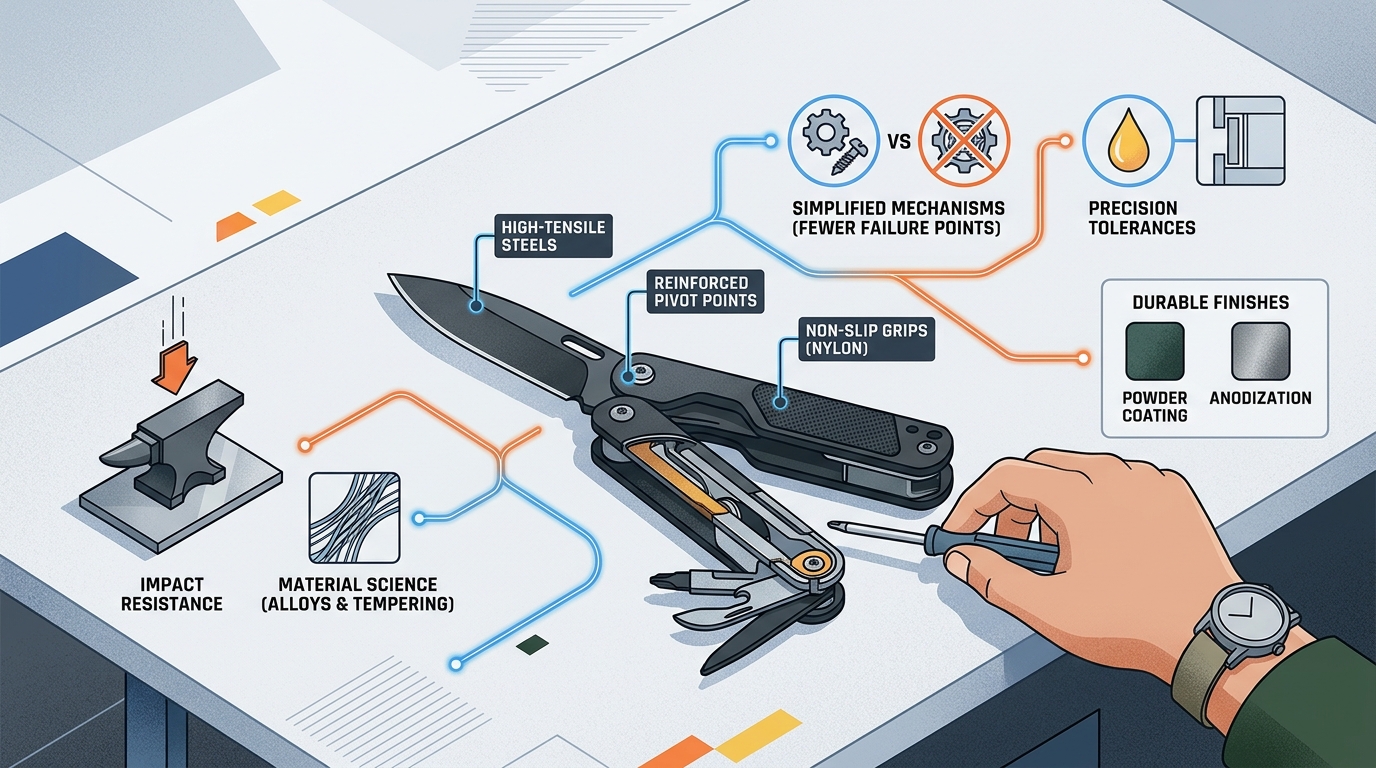
That is why a heavy body, a hard finish, or a rugged appearance cannot independently guarantee a long service life. The real test is whether the item's critical components suit their workload, whether connections remain reliable, and whether the design tolerates the conditions in which it is carried. Affordable equipment can perform well when those fundamentals are sound, but low cost does not excuse ignoring defects or safety limitations.
A practical evaluation begins with the intended task, prioritizes the most consequential failure points, and separates cosmetic aging from functional deterioration. It also recognizes exceptions: lightweight construction can be appropriate, repairability can sometimes matter more than maximum strength, and extreme-abuse demonstrations may reveal less than ordinary repeated use. No simple checklist can guarantee years of service, but a disciplined approach can identify avoidable risks and guide sensible maintenance.
Ultimately, dependable everyday carry gear does not need to be indestructible. It needs to be appropriate for its purpose, consistent in construction, manageable to maintain, and replaced when its condition makes continued use unsafe or unreliable. Understanding those principles provides a far stronger foundation for judging affordable equipment than appearances or price alone.


Comments
Post a Comment