The Common Mistake That Drastically Reduces Your Budget EDC Flashlight's Lifespan
Budget EDC flashlight longevity depends on more than the quality of the LED or the strength of the aluminum body. One of the easiest ways to shorten the useful life of an affordable everyday carry flashlight is to leave batteries inside it for long periods without checking their condition, especially when the light spends weeks or months unused. Battery leakage, corrosion, deep discharge, and poor electrical contact can turn an otherwise functional pocket light into an unreliable tool.
The mistake is easy to overlook because a flashlight can sit quietly in a drawer, backpack, glove compartment, or emergency kit without showing any obvious signs of trouble. When it is finally needed, the light may flicker, produce less illumination, refuse to turn on, or show damage around the battery compartment. Sometimes the problem is simple to fix. In other cases, corrosive battery residue or damaged contacts can make replacement more sensible than repair.
The key message
If you carry your flashlight daily, inspect its battery compartment periodically. If you store it for an extended period, follow the manufacturer's battery-removal guidance and use the correct storage method for that battery chemistry. A modest maintenance routine can prevent avoidable electrical damage without requiring expensive tools or complicated servicing.
1. The Common Mistake: Leaving Batteries Inside an Unused Flashlight
A battery-powered flashlight is an electrical system, not simply an LED attached to a metal tube. Its performance depends on the battery, contacts, driver circuit, switch, seals, and the connections between those parts. Even when the flashlight is switched off, its batteries remain inside an enclosed compartment where temperature changes, moisture, aging, and battery chemistry can affect long-term reliability.
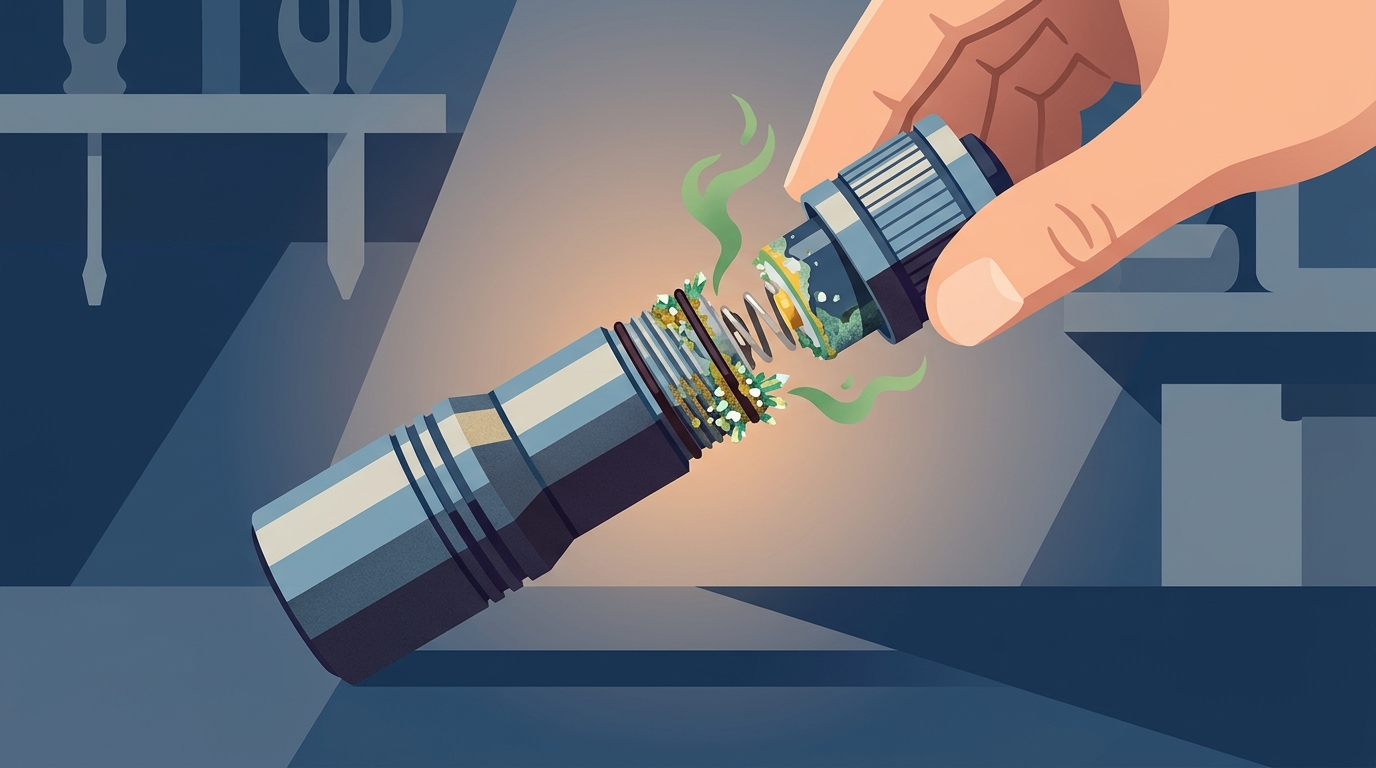
Primary alkaline batteries are particularly worth monitoring during extended storage. As they age, they can develop internal chemical changes that eventually cause electrolyte to escape. If leakage reaches the flashlight's springs, metal contacts, threads, or circuit components, it may interfere with electrical conduction and damage surfaces that are difficult to replace.
The result is not always dramatic. A flashlight might initially work only when shaken, produce intermittent light, or become noticeably less reliable. Corrosion can increase electrical resistance, while residue may obstruct the contact between the battery terminal and the flashlight's conductive parts. Severe contamination can spread beyond the battery compartment and affect the driver or switch.
There is an important distinction between leaving a flashlight loaded for a normal day's carry and forgetting about it for an entire season. A light used frequently, with fresh batteries and regular inspections, does not necessarily need its batteries removed every night. The bigger risk is prolonged, unattended storage combined with aging batteries, unsuitable temperatures, or neglected maintenance.
2. Why Battery Damage Can Shorten the Life of the Entire Light
Battery leakage is only one part of the problem. Understanding the different failure mechanisms makes it easier to decide which preventive action matters most.
Corrosion increases electrical resistance
Flashlight contacts need clean, conductive surfaces to deliver current to the LED driver. Deposits from leaking batteries can interfere with that connection. When resistance increases, the flashlight may experience voltage drop, flickering, intermittent operation, or failure to start under load.
Cleaning a mildly contaminated contact may restore operation, but extensive corrosion can pit the metal, weaken a spring, damage plating, or attack nearby components. Once a contact is physically compromised, repeated cleaning may not restore dependable performance.
Deep discharge can damage rechargeable cells
Rechargeable lithium-ion batteries introduce a different storage concern. A cell that is already low on charge can gradually lose additional charge during storage. If its voltage falls below the safe operating range, it may become unusable or unsafe to recharge, depending on the cell and its protection circuitry.
Many modern flashlights have electronic switches, indicator lights, or standby features that can draw a small amount of current even when the main LED is off. This is sometimes called parasitic drain. It does not affect every flashlight equally, but it means that switching a light off is not always the same as electrically disconnecting the battery.
If your flashlight has electronic controls and will remain unused for months, check its manual for lockout, mechanical disconnection, or storage instructions. If the model supports physical battery isolation, that may be more reliable than depending on an electronic standby state alone.
Temperature changes accelerate battery aging
Heat can accelerate unwanted chemical reactions inside batteries, while extreme cold can temporarily reduce their ability to deliver current. Repeated exposure to high temperatures can also age battery materials and seals. A closed vehicle, a sunny windowsill, or a storage area beside a heater is therefore a poor choice for long-term flashlight storage.
Cold conditions deserve a little nuance. A cold battery may perform poorly even when it is not permanently damaged. Once it returns to a suitable temperature, some of that temporary performance loss may disappear. However, a cold environment does not justify charging a lithium-ion cell while it remains below the manufacturer's permitted charging temperature.
3. Match the Maintenance Routine to the Battery Type
There is no universal battery-storage rule because alkaline, lithium primary, and rechargeable lithium-ion cells have different characteristics. The correct choice depends on the chemistry, the flashlight design, and how long the light will remain unused.
Use the battery label and flashlight manual to identify the permitted cell type before changing your storage routine. A flashlight designed for one battery format should not be assumed to support another simply because the cells fit inside the tube.
The table is a starting point, not a substitute for model-specific instructions. For example, removing alkaline cells before storing an emergency light for several months is a sensible precaution. For a rechargeable lithium-ion flashlight, the better approach may be to remove the cell if the design allows it, or to use the recommended storage charge and disconnect the battery if necessary.
Do not assume that every lithium battery should be stored fully charged, fully discharged, or at the same charge level. Storage recommendations differ by chemistry and manufacturer. The same principle applies to temperature limits and inspection intervals.
4. Battery Storage Is Not the Only Longevity Factor
Although battery neglect is a major preventable risk, it is not the only reason a budget flashlight can fail prematurely. An affordable light can have sound electronics and still become unreliable because its seals dry out, its threads collect grit, or its electrical contacts are repeatedly exposed to moisture.
Neglecting O-rings and water-resistant seals
Many compact flashlights use O-rings to help keep water and dust out of the battery tube, head, or charging-port cover. These seals can wear, become contaminated, or lose their ability to seat properly. Opening the light for battery changes can introduce dirt into the sealing surfaces, and forcing a cap over a displaced O-ring may pinch or damage it.
Inspect seals for cuts, flattening, swelling, and obvious deterioration. If the manufacturer specifies a compatible lubricant, apply it sparingly as directed. Excess lubricant is not a substitute for an intact seal, and an incompatible petroleum-based product may damage some rubber materials. Do not assume that every O-ring needs frequent lubrication or that a lubricated light automatically retains its original water resistance.
Cleaning contacts with the wrong materials
Battery terminals and flashlight contacts should be clean and dry. Aggressive scraping, abrasive paper, metal tools, or unsuitable solvents can remove protective plating, deform springs, or damage plastic parts. A dry, lint-free cloth may be enough for ordinary dust. More persistent contamination requires a method compatible with the specific materials and the manufacturer's service instructions.
If leakage has occurred, identify the cell chemistry before attempting cleanup. Alkaline battery residue and residues from other battery types do not necessarily respond to the same treatment. Do not mix cleaning chemicals or pour liquids into an assembled flashlight. When corrosion has reached the electronics, or when the correct cleanup method is uncertain, professional service or replacement may be the safer choice.
Repeated exposure to water beyond the light's rating
A flashlight advertised as water-resistant is not necessarily waterproof under every condition. Its rating applies within specified test conditions, and damaged seals, loose caps, worn charging-port covers, or improper assembly can reduce protection. Salt water, dirty water, and prolonged immersion can create additional problems.
After exposure to moisture, follow the manufacturer's drying and inspection instructions. If water appears inside the battery compartment, stop using the light until it has been safely inspected and dried. Do not charge a wet flashlight or a wet rechargeable cell.
5. A Practical Action Check for Better Budget EDC Flashlight Longevity
You do not need a complicated maintenance schedule to protect a small everyday carry light. A short inspection before long storage and a periodic check during regular use can catch many problems while they are still easy to address.
Flashlight maintenance checklist
- Confirm that the battery chemistry, size, polarity, and voltage are approved for the flashlight.
- Inspect battery wrappers and terminals for dents, tears, leakage, swelling, or unusual residue.
- Check the battery compartment for discoloration, moisture, damaged springs, and corroded contacts.
- For extended storage, follow the manual's battery-removal or storage-charge instructions.
- Keep the flashlight and spare batteries away from direct sunlight, heaters, and extreme temperatures.
- Inspect O-rings and threaded connections whenever the light is opened for maintenance.
- Use only manufacturer-compatible cleaning products and seal lubricants.
- Test the switch, brightness settings, and charging function, if present, before relying on the light for an emergency.
- Store spare cells in a protective case, especially when carrying them with keys, coins, or other conductive objects.
- Replace damaged, leaking, or unreliable batteries rather than attempting to extend their service life.
How often should you perform these checks? There is no single interval that fits every flashlight and battery. For a light used every day, a quick visual inspection during routine battery changes is practical. For an emergency flashlight that sits unused for months, establish a recurring calendar reminder based on the manufacturer's guidance and the battery's condition.
If you carry a light that uses replaceable alkaline cells, removing them before extended storage is often a useful precaution. If you rely on a rechargeable model, determine whether the battery is removable, whether the switch draws standby current, and what charge level the manufacturer recommends for storage.
6. Choose the Right Action for the Problem You Actually Have
Good maintenance is not about disassembling every flashlight as often as possible. Unnecessary servicing can introduce dust, damage threads, disturb seals, and create new opportunities for mistakes. The more useful strategy is to match the response to the symptom.
Consider three common decisions:
- If the flashlight is working normally and you use it every day, inspect it during routine battery changes instead of repeatedly opening it without a reason.
- If the flashlight will remain unused for months, follow its long-term battery-storage guidance and avoid leaving aging cells unattended.
- If leakage has damaged the contact plating or reached the circuit board, do not assume that a quick wipe will restore reliability. Assess the damage before trusting the light again.
This approach balances prevention with practicality. Budget EDC flashlight longevity improves when maintenance addresses real risks rather than adding unnecessary steps to every use.
7. Cautions and Exceptions You Should Not Ignore
Safety warning
Never attempt to recharge a non-rechargeable battery. Do not charge a damaged, swollen, leaking, unusually hot, or wet rechargeable cell. Stop using a battery that shows signs of damage, and do not open or puncture a lithium-ion cell. Keep leaking batteries away from skin and eyes, follow the manufacturer's handling and disposal guidance, and seek appropriate medical advice if exposure causes injury or irritation.
If a battery becomes hot, vents, or shows signs of thermal failure, avoid handling it unnecessarily and move away from the immediate hazard. Follow local emergency guidance if there is smoke, fire, or a continuing safety risk.
There are also legitimate exceptions to the advice to remove batteries for long storage. Some flashlights are designed around an integrated rechargeable battery that cannot be removed without specialist service. In that case, follow the model's instructions for storage charge, electronic lockout, temperature, and periodic inspection rather than trying to dismantle the device.
Likewise, a flashlight intended for immediate emergency access may need to remain ready for use. Removing its battery can prevent the light from being available when it is needed. If immediate readiness is essential, choose a maintenance schedule and battery type appropriate for that role, inspect the unit regularly, and keep a separate backup if practical.
Another exception concerns well-designed lights with reliable electronic protection and low standby drain. Their storage risks may differ from those of a simple light with a mechanical switch. Protection circuitry can reduce certain risks, but it does not make a damaged battery harmless or eliminate all long-term aging.
Finally, do not confuse every performance decline with battery neglect. An aging LED, failing driver, worn switch, loose connection, damaged charging port, or poor-quality component can cause similar symptoms. If a verified, compatible battery does not solve the problem, investigate other causes instead of repeatedly purchasing cells.
8. Frequently Asked Questions
Should I remove the batteries from my EDC flashlight every night?
Usually, that is unnecessary for a flashlight you carry and use daily, provided the cells are compatible and the battery compartment is in good condition. For prolonged storage, especially with alkaline batteries, removal is a sensible precaution when the design permits it. Follow the flashlight manufacturer's instructions if they specify a different procedure.
How long can I leave batteries inside a budget flashlight?
There is no universal safe duration. The answer depends on battery chemistry, battery age, temperature, the flashlight's standby current, and the manufacturer's recommendations. Inspect frequently used lights during normal maintenance and establish periodic checks for lights stored for months. Do not rely solely on the printed battery expiration date as a guarantee against leakage.
Can corroded flashlight contacts be cleaned?
Sometimes. Light surface contamination may be removable with an appropriate cleaning method, but deep pitting, damaged plating, broken springs, or corrosion that reaches electronic components may require replacement or professional repair. Identify the battery chemistry before cleaning, avoid mixing chemicals, and never work on a powered or actively leaking battery assembly without appropriate precautions.
Does lubricating the O-rings make my flashlight waterproof?
No. Compatible lubricant can help maintain certain seals, but it cannot repair a torn, flattened, missing, or incorrectly seated O-ring. Water resistance also depends on threads, charging-port covers, assembly, and the model's actual rating. Follow the manufacturer's maintenance procedure and do not assume that servicing a seal restores the original rating.
Is it safe to leave a rechargeable lithium-ion flashlight fully charged?
It depends on the cell and the flashlight manufacturer's instructions. Long-term storage at a high state of charge can contribute to battery aging, while excessive discharge can also damage a cell. Follow the specified storage-charge recommendation and avoid extreme temperatures. Do not apply a generic charge-level rule to every rechargeable flashlight.
Why does my flashlight flicker even after I install fresh batteries?
Possible causes include dirty contacts, a weak or damaged spring, an improperly tightened battery cap, a worn switch, or a failing driver circuit. Check polarity and compatibility first, then inspect accessible contacts and connections according to the manual. If flickering continues, avoid assuming that more battery changes will solve the issue.
Can I store a flashlight in my car as an emergency tool?
You can, but a vehicle is not an ideal environment for long-term battery storage because cabin temperatures can become very high or very low. Heat can accelerate battery aging, while cold can reduce immediate output. Use a flashlight and battery combination suited to the expected conditions, inspect it regularly, and avoid leaving vulnerable rechargeable cells in extreme temperatures.
When should I replace a budget flashlight instead of repairing it?
Replacement may make more sense when corrosion has reached the electronics, the body or battery compartment is badly damaged, a seal cannot be replaced, or safe battery operation can no longer be assured. If the fault is limited to an accessible, replaceable battery or a serviceable contact, repair may be reasonable. The deciding factors are the extent of damage, parts availability, repair cost, and confidence in the result.
9. The Real Lesson: Prevent the Failure Before It Starts
The biggest advantage of maintaining an affordable EDC flashlight is not that every inexpensive light can be made to last indefinitely. No maintenance routine can eliminate component defects, battery aging, accidental damage, or the effects of harsh environments. The goal is to avoid preventable failures that make a useful tool unreliable long before its other components reach the end of their service life.
Start with the battery compartment because it is accessible, important to electrical performance, and often overlooked during storage. Identify the battery chemistry, inspect for leakage or damage, and choose a storage method appropriate to the light's design. Then extend that same practical attention to contacts, O-rings, charging ports, and temperature exposure.
When a light works normally, keep maintenance simple. When it will sit unused for months, prioritize safe battery storage. When symptoms appear, identify the likely failure mechanism before replacing parts. And when corrosion or battery damage creates a safety concern, stop using the device until it has been assessed.
That is the practical foundation of budget EDC flashlight longevity: understand the battery, protect the electrical connections, respect the limits of the seals, and avoid unnecessary exposure to heat and moisture. A few deliberate checks can preserve the usefulness of an affordable flashlight while helping you recognize when cleaning, repair, or replacement is the responsible next step.


Comments
Post a Comment